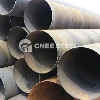
Q275A is a carbon structural steel grade under the Chinese GB/T standard. The "Q" denotes its yield strength, with a minimum yield point of 275 MPa. The "A" signifies a quality grade, indicating a certain level of phosphorus (P) and sulfur (S) content control. Pipes made from this steel are typically produced as seamless or welded pipes and serve as a fundamental material in various industrial sectors.
1. Primary Applications and Use Cases
Q275A steel pipes, with their good strength and weldability, are widely used in structural and mechanical applications that do not require extreme toughness or specialized properties.
They are commonly used in the construction of factory buildings, warehouses, and other industrial structures for elements like roof trusses, columns, and support frames.
Due to their better strength than Q235 steel, they are suitable for manufacturing parts that bear moderate static loads, such as bolts, pins, shafts, and connecting rods in machinery.
For low to medium-pressure fluid transmission systems that are not highly corrosive, such as water and air pipelines.
Widely used in the fabrication of frames for agricultural machinery, material handling equipment, and simple construction equipment.
Often used as a base material for products that will undergo further processing or fabrication.
2. Key Advantages and Benefits
The popularity of Q275A steel pipes stems from a balanced combination of performance and cost-effectiveness.
Cost-Effectiveness: As a common carbon steel, Q275A offers a very favorable price-to-performance ratio. It provides a significant strength upgrade over lower grades like Q235 without a substantial cost increase, making it an economical choice for many projects.
With a yield strength of >=275 MPa and tensile strength of 410-540 MPa, it possesses good load-bearing capacity and rigidity, suitable for many structural applications.
Its carbon content is moderate, making it easy to weld, cut, bend, and form using standard workshop techniques. This reduces manufacturing complexity and costs.
Q275A is a standard and widely produced grade in China, ensuring easy sourcing and a stable supply chain.
3. Future Development Prospects and Challenges
The future of Q275A steel pipes is intertwined with broader industrial trends, facing both opportunities and challenges.
In developing regions and for domestic infrastructure projects, there will be continuous, stable demand for reliable and affordable structural materials like Q275A.
The modernization of agriculture and development in rural areas will drive demand for machinery, greenhouses, and storage facilities, all of which are key application areas for Q275A pipes.
As manufacturing processes like controlled rolling and cooling improve, the consistency and quality of Q275A pipes can be enhanced, potentially opening up more demanding applications.
Competition from High-Strength Steels: The growing emphasis on lightweight and high-performance design is pushing industries towards higher-strength, low-alloy (HSLA) steels like Q355 and above. These steels allow for thinner, lighter structures, which Q275A cannot compete with in advanced applications.
Stricter environmental regulations may impact the traditional steel production process. The future lies in more sustainable production methods, and basic grades like Q275A will need to adapt.
While its market share in high-end applications may shrink, Q275A is likely to remain a dominant material in cost-sensitive, medium-duty applications where its performance is perfectly adequate.
In summary, the Q275A steel pipe is a versatile and economically efficient material that plays a crucial role in foundational industries. Its key advantages are its cost-effectiveness, good strength, and ease of fabrication. While its long-term future faces pressure from advanced high-strength alternatives, it will remain a vital and widely used material for general structural and mechanical applications, particularly in markets where initial cost is a primary driver.